
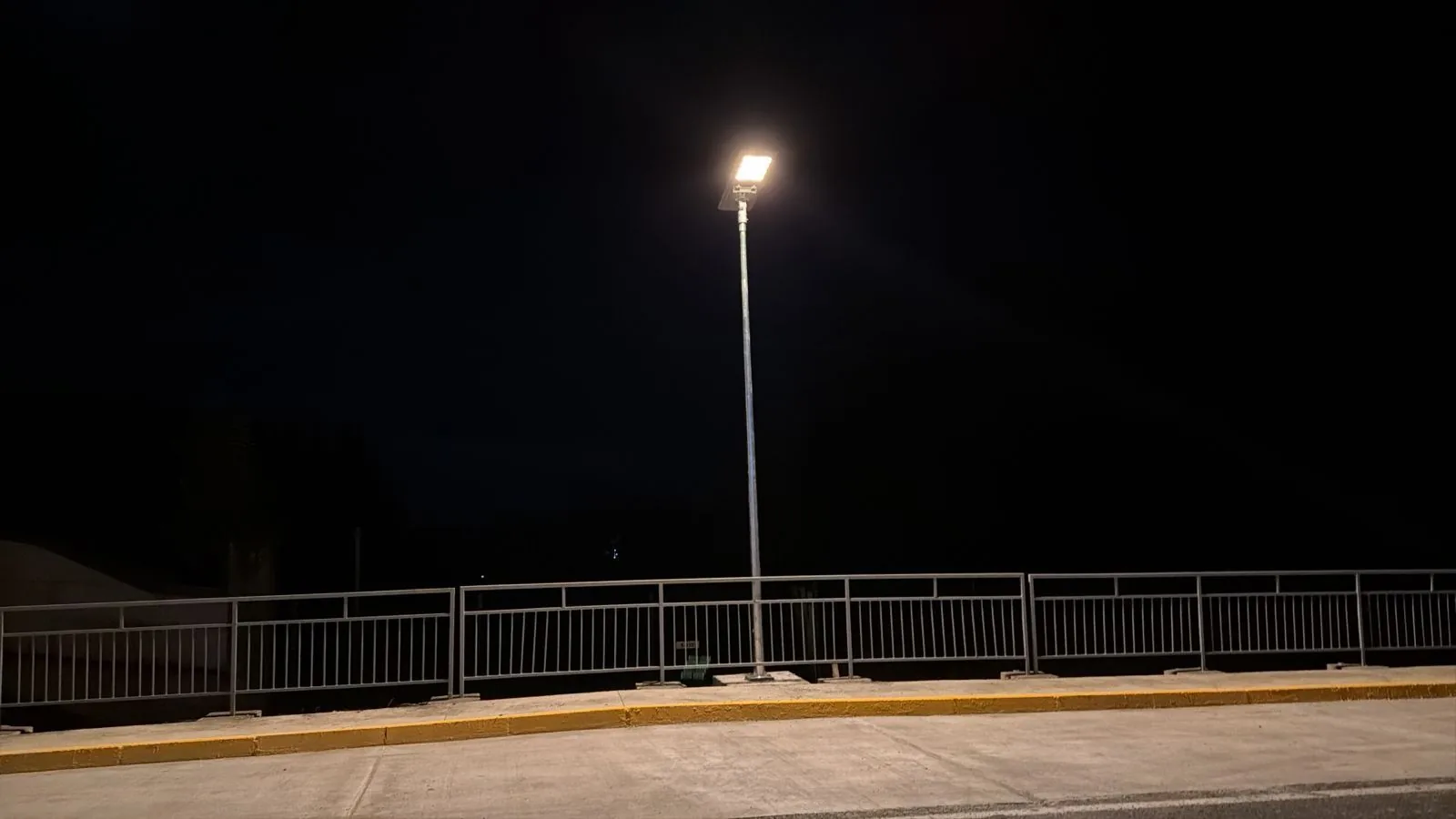
A 2.4 km rural stretch, 28 points, lighting class M5. The quote comes back with three lines: luminaires, poles, and "grid extension, 1.8 km with transformer". The third line costs more than the first two together, and its schedule is not the supplier's to control: it depends on the utility, the municipality and the right of way.
In Europe the same stretch never generates that line. The grid already runs past the frontage, and the decision is between two luminaires. Across much of Latin America the decision comes earlier: whether the road is lit with the grid or without it.
Every solar-versus-grid comparison assumes two things: that the grid exists and that connecting is paperwork. When the assumption holds, comparing price per luminaire makes sense. When it does not, the two options are not competing: a luminaire is being compared against an infrastructure project.
That shift explains why so many tenders in the region end up void or over budget. It is not that solar is expensive; it is that the budget was built on a grid that is not there.
Once the connection is gone, four things stop being optional.
Two days of autonomy looks sufficient until a week of rain arrives. The system does not fail because of a defective part: it fails because it was sized on the average instead of the worst month, and because the battery lost capacity in year three without anyone noticing.
It is a silent, collective failure. A single point does not go dark; the whole stretch does, on the same night, and the complaint reaches the municipality, not the manufacturer. That is why autonomy is the first figure to require and the last one anyone checks in a tender.
Solar is not a religion. There are cases where the grid wins clearly.
If all three answers exist in writing, the comparison is possible. If the third has no answer, the problem is not technical: nobody is going to maintain what gets installed.
How to turn those three answers into a purchase document is covered in the municipal tender guide.
Does solar work in areas with heavy rain? Yes, with autonomy sized on the worst month rather than the average. In the Amazon four or five days are specified; elsewhere in the region, three usually suffice.
How long does the battery last? Six to eight years in a correctly sized system, at 3,000 cycles to 80% depth of discharge. The life of the system is set by the battery, not by the luminaire.
Can solar cover one stretch and the grid another? It is the most common arrangement on long roads: grid where it already exists, solar where the extension cannot be justified. A tender can be split by stretch without losing technical coherence.
Is the cost per kilometre comparable? Only if the grid extension, the transformer and the schedule are included. Comparing luminaire price with luminaire price leaves out exactly the line that decides. The full derivation is in the per-kilometre calculation.
Luxey Lighting has manufactured solar luminaires in Shenzhen since 2007 and exports to 76 countries. This article describes project conditions; every site has its own rules and its own network operator, which prevail over these observations.
Our 25-engineer team provides free project consultation and fast, accurate quotations.
Get a Quote