
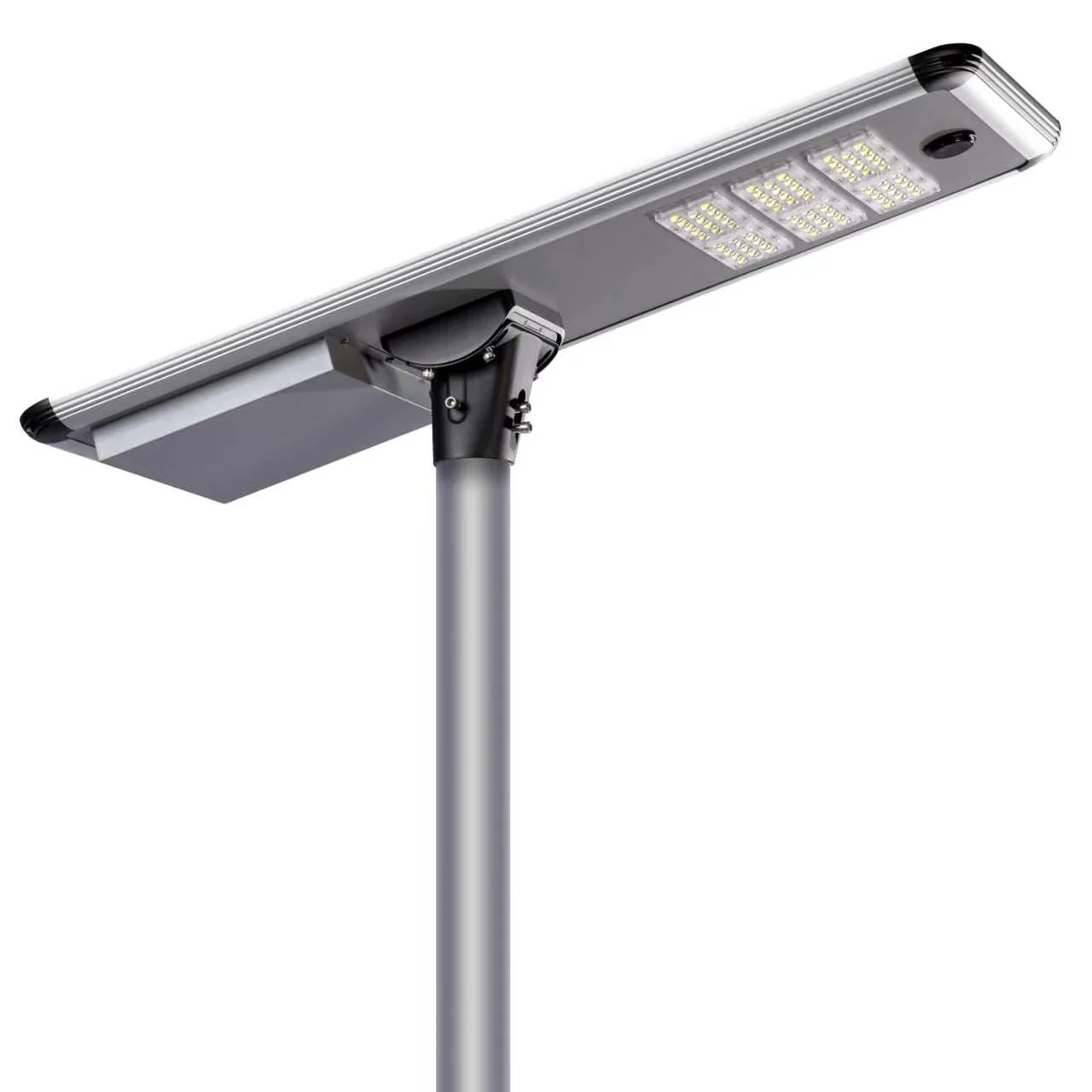
Almost every quotation request asks the price of a kilometre, not the price of a luminaire. It is the unit a rural road, a municipal street or a secondary highway is budgeted in, and the only one that lets you compare two offers that arrive with different numbers.
This article runs the calculation in the order the site does it: how many points fit in a kilometre, how much power each point needs, what battery that implies, and which cost blocks make up the total. At the end there is a worked example with the assumptions written down, so you can replace them with yours.
The first number that fixes the cost is not electrical, it is geometric. At 30 m spacing a kilometre holds 34 points; at 40 m, 25; at 50 m, 20. Spacing is not chosen by budget, it is chosen by road class and by the uniformity that class demands: wider spacing lowers the installation cost and raises the wattage per point, and beyond a certain point it stops complying.
That is why two offers at the same price per luminaire can differ by 40% per kilometre: one carries 34 points at 40 W, the other 22 points at 80 W. Before comparing prices, compare the point count and the spacing.
The flux you need comes from the road's lighting class, M3, M4, C3 or C4, or whatever the tender specifies, and from the geometry. A rural road usually asks for 3,000 to 5,000 lumens per point on 6 m poles; a collector road rises to 6,000 or 8,000 lm on 8 m poles.
Once the flux is fixed, the panel follows from daily energy: lamp wattage times burning hours, divided by the worst-month peak sun hours and by system efficiency. A 40 W point burning 11 hours uses 440 Wh; at 4.5 peak sun hours and 75% efficiency it needs about 130 Wp, which in practice is specified as 150 to 180 Wp to cover ageing and soiling.
Autonomy is the variable that changes the price most and gets discussed least. Three days of autonomy for 440 Wh a day is 1,320 Wh usable; at 80% depth of discharge that is about 1,650 Wh nominal, which is 130 Ah at 12.8 V or 65 Ah at 25.6 V.
Going from two to four days of autonomy adds 20% to 30% to the system cost and changes nothing visible on day one. It changes in year three, when a week of rain arrives. This is the line item to decide with the site's climate data rather than with habit.
A solar project per kilometre is made of four blocks. The percentages move with country, quantity and pole height, but the order of magnitude holds.
| Block | What it covers | Typical share |
|---|---|---|
| Solar luminaire | Panel, battery, controller, optics, housing | 45% to 55% |
| Pole and foundation | Pole, base plate, anchor bolts, excavation, concrete | 20% to 25% |
| Installation | Lifting, mounting, connection, commissioning | 10% to 15% |
| Freight and clearance | Sea freight, insurance, customs, delivery to site | 10% to 20% |
The block a cheap offer cuts is almost never the first one. It is the second: thinner poles, smaller foundations, ungalvanised bolts. You notice at the second winter.
The initial cost is not the cost. Over eight years a correctly sized solar system replaces the battery once, in year six or seven, and makes two or three maintenance visits. That replacement runs 15% to 20% of the initial system cost, which is why a 3,000-cycle battery changes the arithmetic: if it lasts eight years instead of four, the replacement leaves the payback horizon entirely.
Against a grid extension, the crossover is usually distance. With few points per kilometre and a nearby line, the connection wins; on long, dispersed stretches with no grid, solar wins by a wide margin. That crossover is what the TCO calculator computes with a project's own numbers.
Take a rural road of 1 km, 6 m poles every 30 m, 40 W per point, 11 burning hours, three days of autonomy, in an area with 4.5 peak sun hours in the worst month.
That is the skeleton. What differs between offers is not the formula but each assumption: if someone budgets 25 points instead of 34, or two days instead of three, the number falls and the road goes dark in the wrong week.
Three questions separate a complete offer from a bare price.
If all three answers arrive with numbers, the comparison is possible. If they arrive as adjectives, there is no price to compare.
How many light points fit in a kilometre? At 30 m spacing, 34 points; at 40 m, 25; at 50 m, 20. Spacing is set by road class and required uniformity, not by budget.
How much power does each point need? Between 30 W and 50 W for a rural road on 6 m poles at 4,000 lm; a collector road on 8 m poles needs 60 W to 100 W and more flux.
Why do two offers per kilometre differ so much? Almost always through point count, days of autonomy or pole wall thickness. Compare those three before the unit price.
Is the battery replaced within the project life? Yes, once between year six and year eight in a correctly sized system. That replacement is 15% to 20% of the initial cost and belongs in the budget.
Luxey Lighting has manufactured solar luminaires in Shenzhen since 2007 and exports to 76 countries. The figures in this article are a worked example with explicit assumptions, not a quotation; every project is sized on its own climate and its own road.
Our 25-engineer team provides free project consultation and fast, accurate quotations.
Get a Quote