
A 150 W high-pressure sodium street light replaced by a 60 W LED saves 90 W. At 4,000 hours a year that is 360 kWh per pole; at €0.15 per kWh it is €54 a year, every year, for the life of the fixture. Multiply by a city's pole count and the sustainability argument becomes an accounting argument.
But is energy efficiency enough?
As leading markets like Chile, Spain, and France implement strict new environmental mandates, a critical but often overlooked factor has come to the forefront: The quality of the light itself.
When we look at traditional LED street lighting (the common 6500K cool white light), we see a hidden threat. While these lights are energy-efficient, they are often high in blue light content and glare.
The consequences are significant:
For Humans: Disruption of circadian rhythms and suppressed melatonin production, leading to poor sleep quality.
For Ecosystems: Disorientation of migratory birds, impact on insect populations, and the "erasing" of our night sky.
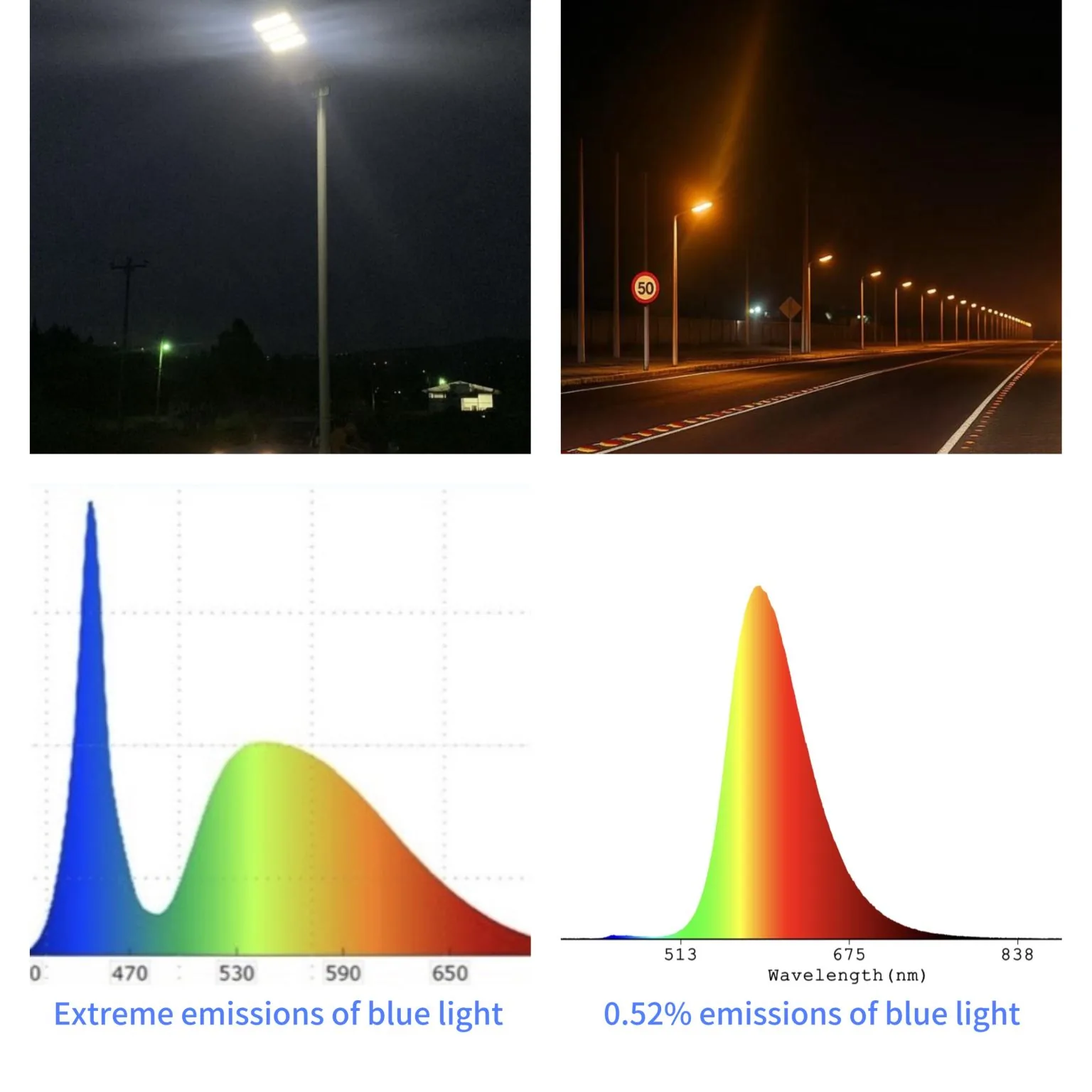
Take a look at the image above. It illustrates the fundamental shift occurring in the industry:
On the Left (Standard 6500K): High blue light spectrum. It’s bright, but it’s invasive. It represents the old way of thinking—saving watts but sacrificing the environment.
On the Right (The Sustainable Path): Our latest implementation. By reducing blue light content to below 1% (using warm-toned 1800K to 2200K LEDs), we protect the rhythm of nature.
Achieving this requires advanced technology and higher engineering standards. However, we believe it is the only way to be truly responsible to our planet.
If a solar lamp saves energy but ruins the night sky and disorients local wildlife, can we honestly call it "sustainable"?
At Shenzhen Luxey Co., Ltd, we believe true sustainability is a two-part equation:
Renewable Energy: Utilizing high-efficacy solar solutions to eliminate carbon footprints.
Light Quality: Ensuring that the impact the light leaves behind is as clean as the energy that powers it.
From a "Dark Sky" perspective, street lights have one primary job: to provide safety for people without creating pollution for the planet.
A common concern is that lower color temperatures mean lower brightness. We have solved this through engineering. By utilizing high-efficacy LEDs (200lm/) and specialized precision lenses, we ensure that our low-blue-light fixtures deliver optimal illumination exactly where it's needed, without wasting light in the atmosphere.
The arithmetic is worth putting in the council paper: 90 W × 4,000 h = 360 kWh per pole per year. A 10,000-pole city saves 3.6 GWh a year, and at €0.15/kWh that is €540,000. The number that decides whether the project is green, however, is not the saving — it is what happens to the 90 W that is no longer burned, and whether the new fixture is dimmed when the road is empty.
As global standards evolve, the choice for project managers and city planners is clear. Does your current project prioritize only the energy source, or are you considering the quality of light?
It is time to rethink the standard together.
Ready to bring Dark Sky compliant lighting to your region?
What is wrong with a standard 6500K LED street light? It is energy-efficient but high in blue light content and glare. For humans that means disrupted circadian rhythms and suppressed melatonin, which shows up as poor sleep; for ecosystems it means disoriented migratory birds, pressure on insect populations and the erasing of the night sky.
How low can the blue content go? Below 1%, using warm-toned 1800K to 2200K LEDs. That is the level the article's sustainable path is built around, and reaching it is presented as an engineering problem rather than a colour choice.
Does a warmer colour temperature mean less light? No. The article answers that concern with engineering: high-efficacy LEDs at 200 lm/W plus precision lenses, so the low-blue fixture still delivers the illumination where it is needed instead of wasting light into the atmosphere.
Which countries are driving the change? Chile, Spain and France, which have implemented strict new environmental mandates. The article frames the shift as efficiency versus responsibility: a lamp that saves energy but ruins the night sky and disorients wildlife is not sustainable.
Our 25-engineer team provides free project consultation and fast, accurate quotations.
Get a Quote