
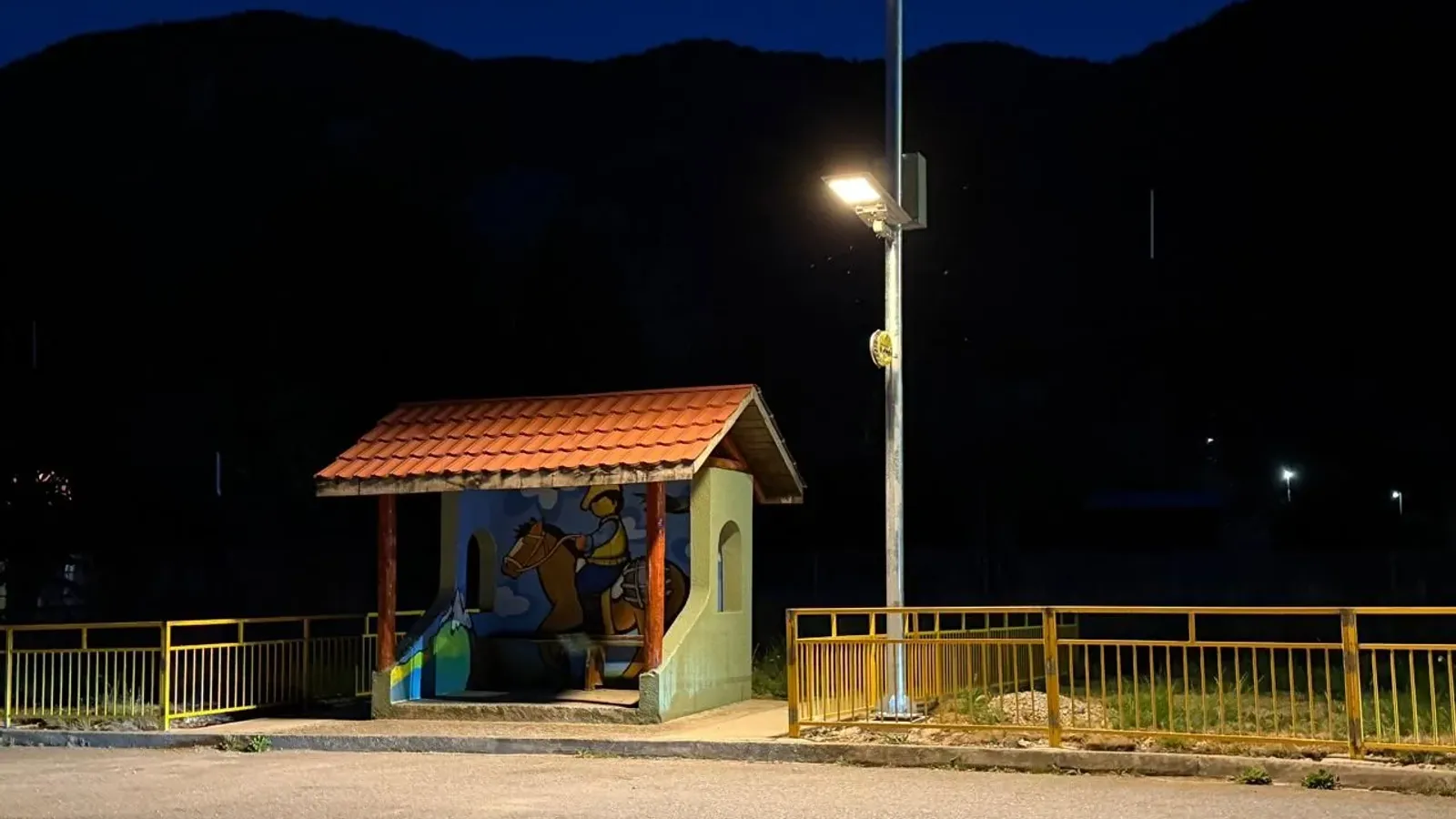
A solar street light 300 metres from the sea is not a wet product. It is a product that is never properly dry. Salt settles on the housing overnight, the morning dew dissolves it into a film of chloride, and that film stays conductive for as long as the air stays humid. Rain washes it off; the onshore wind puts it back within a day.
That difference decides which parts fail. It is rarely the LED. On coastal projects the first failures are usually a powder coat that has lifted at an edge, a screw that has seized in its thread, a gasket that has hardened and taken a set, or a driver board that corroded inside a housing whose IP rating was true on the day it was tested and not on the day it was installed.
Three mechanisms run at the same time, and only the first one is obvious.
The first is the electrolyte film. Rain gives a surface water for minutes or hours. Salt gives it water whenever the relative humidity crosses roughly 60%, because the salt deposit is hygroscopic. A coastal surface therefore spends far more of the year wet than the rainfall chart suggests, and corrosion rate follows wet time more closely than it follows annual precipitation.
The second is pitting. Chloride ions break down the passive oxide film on aluminium and on stainless steel locally rather than uniformly, so the damage is a pit a fraction of a millimetre across and several tenths deep, not an even loss of thickness. A housing can look intact and leak at one point.
The third is the galvanic couple. Once there is a conductive film on the metal, any two dissimilar metals in contact form a cell. Zinc coating, mild-steel screws, stainless screws and aluminium castings sit at different potentials, and the one that becomes anodic corrodes faster than it would alone.
None of this is a property of the luminaire. It is a property of the site. ISO 9223 and BS EN ISO 12944-2 classify atmospheres by how much metal they consume in the first year, and the category is set by chloride deposition, humidity and pollution together, not by distance from the coast alone.
| Category | Typical environment | Carbon steel, first year | Zinc, first year |
|---|---|---|---|
| C3 | Urban, light industrial, low-salinity coast | 25–50 µm | 0.7–2.1 µm |
| C4 | Industrial, or coast with moderate salinity | 50–80 µm | 2.1–4.2 µm |
| C5-M | Coastal and offshore, high salinity | 80–200 µm | 4.2–8.4 µm |
Two practical notes on that table. The UK's National Physical Laboratory treats a 2 km strip around the coast as marine, and in hot humid coastal zones the measured loss can exceed the top of the C5-M band. The category is also local: a pole on the seaward side of a breakwater and the same pole 200 m inland behind a row of buildings are not in the same environment, even though a map puts them in the same postcode.
Coastal service does not attack a street light evenly. Failures cluster in five places, and four of them are cheaper to specify correctly than to repair at height.
| Part | What fails | What it looks like in year four |
|---|---|---|
| Pole coating | Zinc consumed at edges, welds and the base plate | Red rust at the weld toe, white rust on the shaft |
| Fasteners | Galvanised screws in aluminium or stainless contact | Seized threads, heads rounded off at removal |
| Housing finish | Powder coat lifts at a cut edge or a sharp radius | A ring of blistering around the cable entry |
| Sealing | Gasket hardens, takes a compression set, loses rebound | Condensation inside the lens, insects, water tracking |
| Electronics | Chloride reaches the driver board through a cable entry | Driver fails while the LEDs are still good |
The order matters for maintenance. A seized fastener turns a fifteen-minute gasket change into an angle-grinder job at height, and a failed driver on a ten-year-old fixture often ends the whole luminaire's life because the replacement board is no longer made. The cheapest corrosion decision is the one taken in the bill of materials.
Buyers often ask for a salt-spray figure, and suppliers quote one: 500 hours, 1,000 hours, sometimes 2,000. Neutral salt spray testing to ISO 9227 or ASTM B117 puts a coated coupon in a fog of 5% sodium chloride at 35 °C and records when red rust appears. It is a useful, repeatable comparison between two coating systems tested side by side.
It is not a service-life prediction. ASTM B117 states in its scope that the test is comparative and does not specify the period of exposure that will lead to failure in service, and the same caution applies to the ISO method. Three reasons matter here:
A 500-hour result means the coating system is not obviously wrong. It does not mean five years, and a supplier who converts hours into years has either misunderstood the test or is hoping you will.
For steel, the number that matters is the zinc thickness, and ISO 1461 states it by steel thickness rather than by environment. For steel over 6 mm the mean minimum is 85 µm with a local minimum of 70 µm; for 3 mm to 6 mm it is 70 µm mean and 55 µm local. A single reading below the local minimum fails the lot even if the average passes, so the inspection plan is part of the specification.
That thickness then has a service life you can estimate. Dividing 85 µm by the C5-M zinc loss of 4.2 to 8.4 µm per year gives roughly ten to twenty years before the coating is consumed, and that is arithmetic, not a guarantee: edges, weld spatter, damage in transit and a scratched base plate all start earlier than the flat shaft.
Three details decide whether the number survives contact with the site:
For a fifteen-year coastal specification, a duplex system is the usual answer: hot-dip galvanising as the sacrificial base, then surface preparation and a powder or liquid topcoat. The galvanising still does the electrochemical work; the topcoat buys time by keeping the electrolyte off it. A topcoat applied over a poorly prepared galvanised surface peels at the edges within a few years, which is worse than no topcoat, because it hides the zinc loss underneath.
The luminaire housing is usually die-cast aluminium, and aluminium behaves differently from steel. It does not rust; it pits. In a C5-M atmosphere the pitting is driven by chloride and accelerated wherever the coating is thin, which in practice means sharp radii, parting lines and the cut edges of a cable entry.
Four decisions carry most of the outcome:
Condensation is the part of sealing that gets forgotten. A housing that is watertight when tested cold can pull humid air in as it heats and cools each day, and that air condenses on the inside of the lens. A breathable membrane vent equalises the pressure without letting liquid water in, and it is worth specifying explicitly because it is invisible in a photograph and absent from most datasheets.
The following is short enough to paste into a tender and specific enough that a supplier can either meet it or say so before the order.
Items 1, 3 and 10 are the ones most often left out, and they are the three that decide whether the rest can be checked.
Coastal assets need a scheduled inspection, not a complaint-driven one. In year one the job is to establish a baseline: photograph the base plate, the weld toes, the cable entries and the gasket line, and record coating thickness readings on the shaft. Those photographs are what makes a year-five judgement possible.
At each visit, four things are worth ten minutes:
Cleaning matters more on a coast than inland, and the interval is set by how much salt the surface collects, not by a calendar. A freshwater rinse of the lower pole and the housing after the dry season removes the deposit that would otherwise be re-dissolved every morning.
Does an IP66 rating cover salt fog? No. IP ratings describe the ingress of water and solid objects, tested with fresh water and clean dust. They say nothing about chloride deposition, coating adhesion or galvanic corrosion, and a housing can be IP66 and still lose its powder coat at the edges in three years.
Is stainless steel always the right answer on a coast? Not by itself. 304 stainless pits in marine chloride and is a common false economy; A4-70, the 316-grade family, is the usual choice for fasteners. Stainless in contact with galvanised steel in a wet environment creates its own galvanic couple, so isolation washers are part of the specification, not an accessory.
Does a thicker zinc coating always last longer? Up to a point. Coating growth is driven by steel chemistry and immersion time, and coatings beyond roughly 150 to 200 µm become brittle and can flake at bends. The useful move is to specify the ISO 1461 minimum properly, inspect it, and add a topcoat rather than chase thickness alone.
How often should a coastal installation be washed? There is no single number that survives contact with real sites. The working rule is to rinse when the surface visibly holds salt, which in a C5-M location is typically after the dry season and after any storm that carried spray inland. Recording the date and the appearance before and after is more useful than a fixed interval nobody follows.
National Physical Laboratory, The prevention of corrosion on structural steelwork, section on atmospheric corrosivity and bimetallic corrosion (retrieved 2026-11-10).
BS EN ISO 12944-2 and ISO 9223, corrosivity categories and first-year thickness loss, as tabulated in the NPL guide above.
Galvanizers Association, EN ISO 1461: The hot dip galvanizing standard explained, coating thickness table (retrieved 2026-11-10).
ASTM B117, Standard Practice for Operating Salt Spray (Fog) Apparatus, scope statement on comparative use.
ISO 9227, Corrosion tests in artificial atmospheres — Salt spray tests.
Luxey Lighting, LED high mast lights, for the IP65/IP66, IK10 and 26 kV surge specification used on coastal masts.
If you are writing a coastal specification and want the pole, coating and housing clauses checked against a real bill of materials, send the project location and the design life and we will return the clause list with the part numbers.
Our 25-engineer team provides free project consultation and fast, accurate quotations.
Get a Quote