
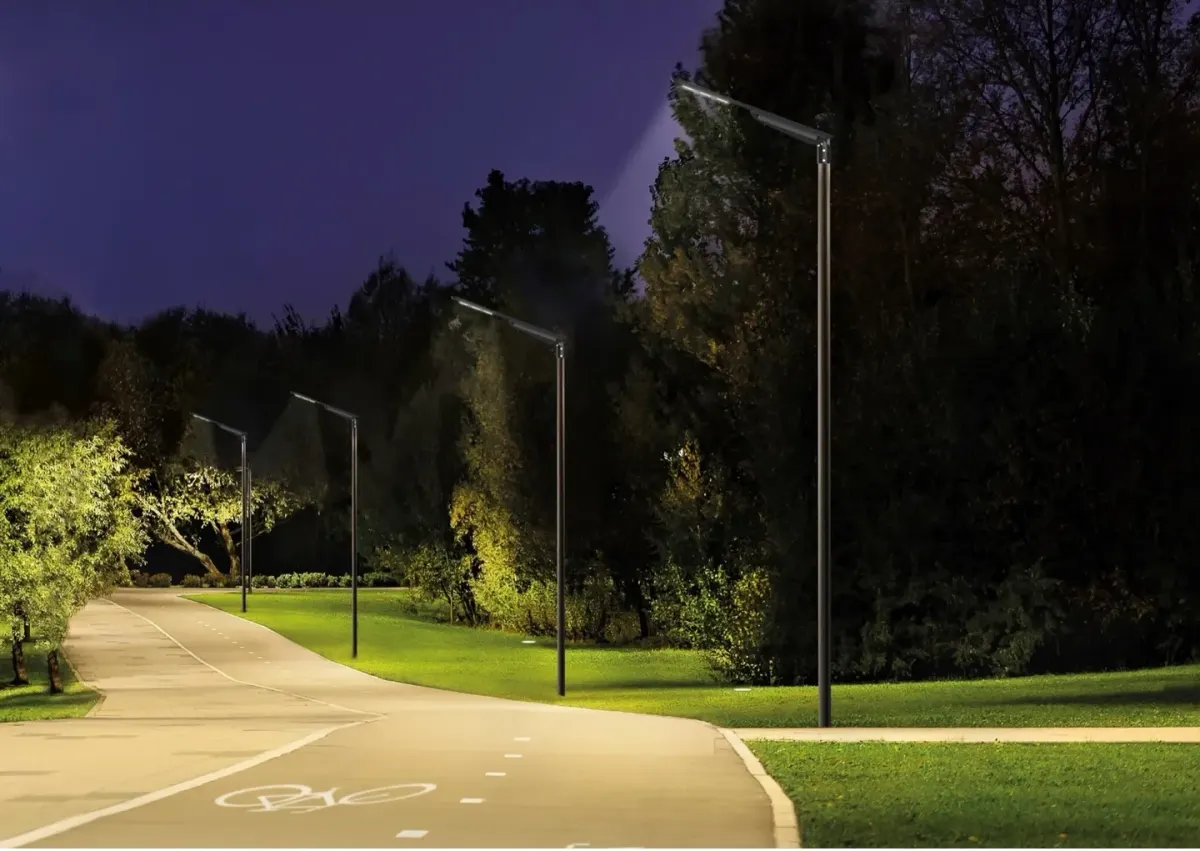
A solar street light is not one product with one expiry date. It is five parts with five different clocks, and the number that decides your maintenance budget is the shortest one you cannot replace. In most fixtures on the market, that part is the battery.
Suppliers answer the question with one figure — ten years, twelve, twenty-five. Those numbers are usually accurate about the panel, which is the part that essentially never fails first. The useful answer is a table, and then the arithmetic behind it, because a lifespan you cannot check is a marketing claim with a decimal point.
This page gives both, and then the six questions that separate a real life expectancy from a hopeful one.
Every figure below assumes the light runs dusk to dawn, about eleven hours a night, in a temperate climate. Move the installation to a hot desert and every number on the battery row shortens.
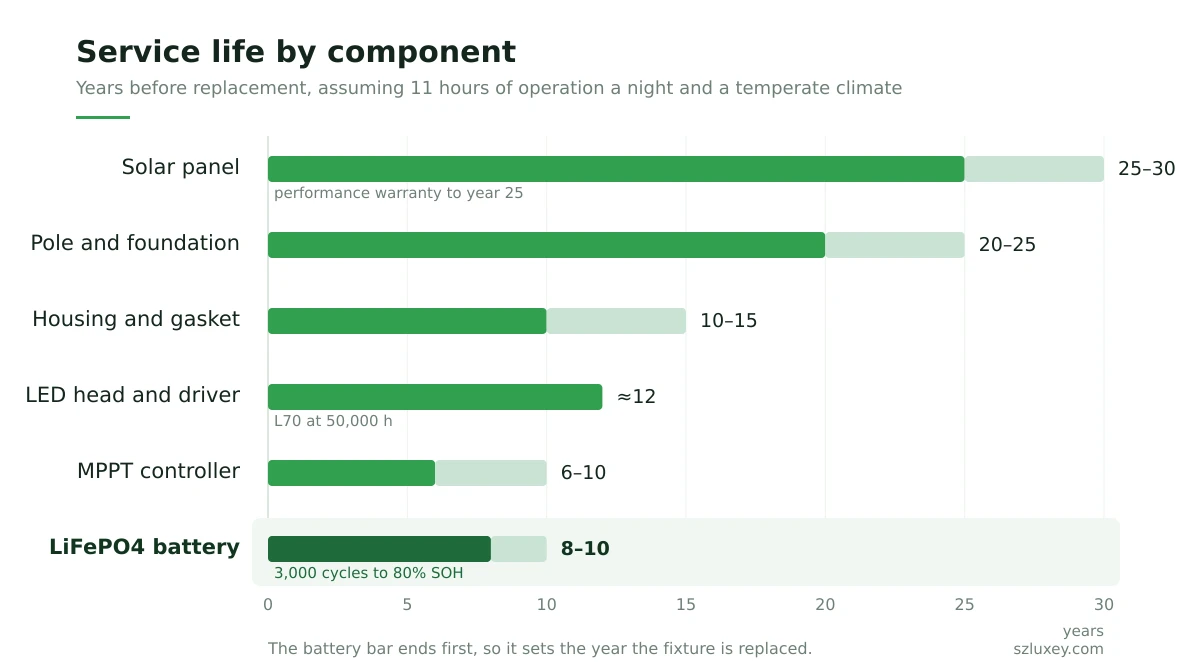
| Part | Rated by | Typical service life | What ends it first |
|---|---|---|---|
| Solar panel | 25-year performance warranty to about 80% of nameplate | 25–30 years | Soiling and shading long before cell degradation |
| LED head and driver | L70 at 50,000 hours, projected from LM-80 data | About 12 years | Junction temperature, then driver capacitors |
| LiFePO4 battery | 3,000 cycles to 80% state of health | 8–10 years | Depth of discharge and cell temperature |
| MPPT controller | No universal standard, 5–10 years in the field | 6–10 years | Surge, water ingress, capacitor aging |
| Housing and gasket | IP65 or IP66 to IEC 60529 | 10–15 years | UV, gasket compression, salt air |
| Pole and foundation | Galvanising to ISO 1461, wind load to EN 1991-1-4 | 20–25 years | Corrosion at the base, undersized footing |
Two things stand out in that table, and both cut against the way the category is sold. The panel is the longest-lived part, so a supplier quoting "twenty-five years" is quoting the part that will not fail. And the battery is the shortest-lived part that costs real money to replace, so it is the number a buyer should actually interrogate.
The battery figure is not a guess. It is division.
A LiFePO4 pack rated 3,000 cycles to 80% state of health, cycled once a night, reaches its end-of-life threshold after 3,000 nights. That is 8.2 years. Thirty-six hundred and fifty nights is a decade, so the rating lands just short of ten years of nightly duty.
The LED figure is the same kind of sum. Eleven hours a night, 365 nights a year, is about 4,000 hours of operation. At 50,000 hours to L70, the head reaches 70% of its original output after roughly 12.5 years. L70 does not mean the light stops working — it means the light has dimmed by 30%, which on a road is the point where people start complaining.
So the two clocks run at different speeds. The LED has four years of margin over the battery, and the panel has another decade over both. That is why the replacement conversation in year nine is a battery conversation, and why any supplier who leads with panel life is answering a question you did not ask.
Two things happen at once around year eight. The pack crosses 80% of its original capacity, which shows up as shorter autonomy after a cloudy week rather than as a sudden failure. And the warranty on the battery — typically three to five years — has already expired. From that point the light is running on borrowed capacity, and the only question is whether replacing the pack is a thirty-minute job or a crane job.
This is also where the rated cycle count and the real cycle count separate. Cycle life is quoted at a stated depth of discharge, and the label rarely says which. A pack that is drained to the floor every night to keep a light on through a bad week will not reach the printed number. The same pack held to a shallow cycle will exceed it. Two installations with identical hardware can differ by three years on this alone.
That is the engineering reason a dim-to-standby profile is not a lighting feature. Dropping output to 30% for the quiet hours cuts the energy taken out of the pack each night, which reduces the equivalent full cycles it sees, which pushes the 80% crossing later. A radar sensor that dims after fifteen seconds of no movement is a battery-life decision wearing a lighting label.
Cheap solar street lights rarely die of LED failure. The pattern is consistent, and it is almost always the power system.
The first failure is a lead-acid or low-grade lithium pack that reaches the end of its usable capacity in two to three years, well before the LED has done a fraction of its rated hours. The second is a driver that cooks because the housing has no thermal path from the LED board to the casting. The third is water — a gasket that was compressed once at the factory and never recovered, letting humidity into the compartment that holds the controller.
None of those are wear-out failures. They are specification and assembly failures that happen to look like old age. A fixture that fails at year three did not have a shorter life; it had a life it was never going to reach.
The rule of thumb for lithium cells is that every 10 °C of sustained extra cell temperature roughly halves calendar life. That is not a small correction. A pack that sits at 45 °C instead of 35 °C for six months a year will lose capacity on a schedule that has nothing to do with how many cycles it has run.
In an all-in-one fixture the battery shares a sealed body with the panel and the LED board, so the design question is where the heat goes. Separating the pack from the panel with a thermal barrier, keeping the LED chamber on the other side of the casting, and leaving air gap around the housing all reduce the temperature the cells actually see. On our own solar street light fixtures that barrier is worth 6 to 8 °C, which is the difference between a pack that reaches its rated cycles and one that fades early.
The same logic applies to installation. A light mounted where the housing sits in direct afternoon sun with no air movement behind it runs hotter than the same light on a pole with clearance. Two identical fixtures, two different service lives, no defect in either.
Ask for these six things. A supplier with real data will answer all of them from documents; a supplier with a brochure will answer two.
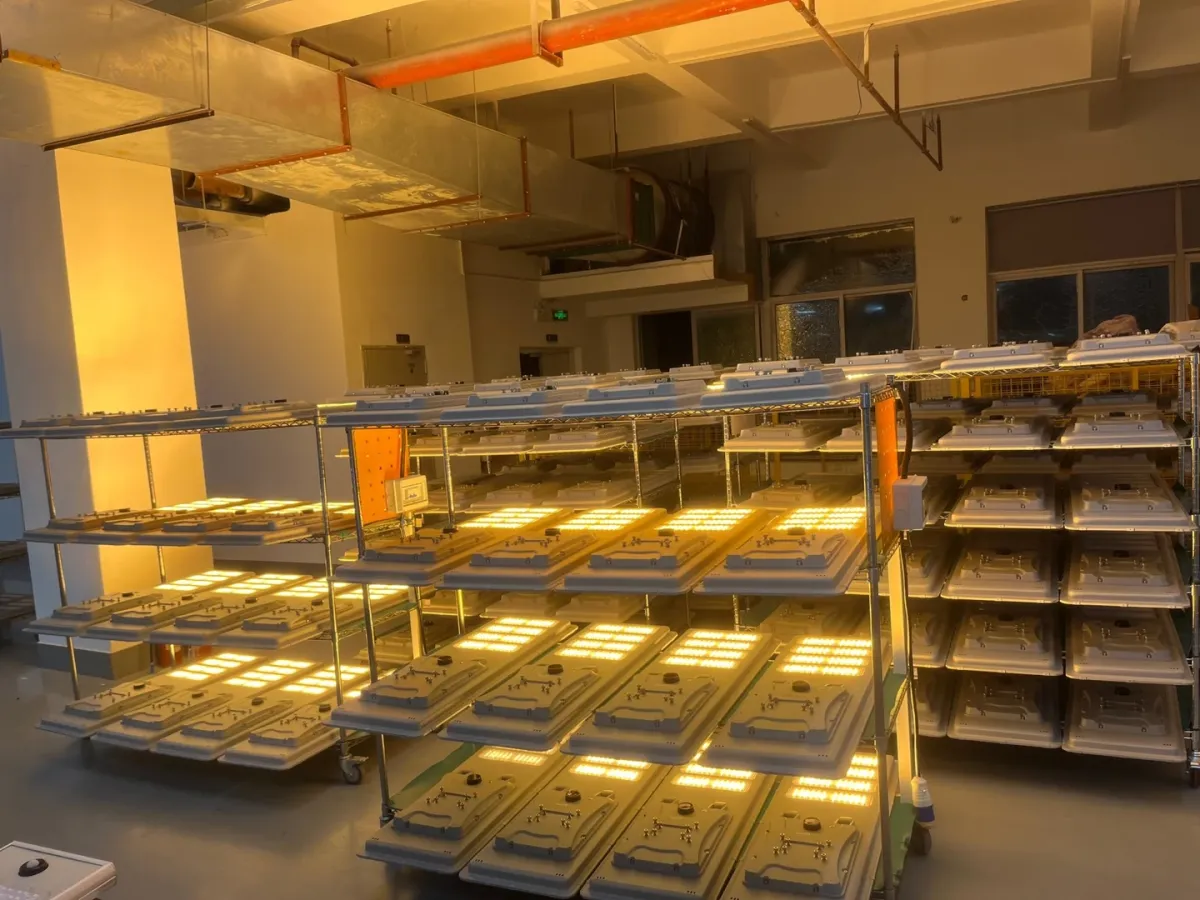
A supplier who can produce an LM-80 report, a cycle test at a stated depth of discharge, and a written service procedure is telling you the product has a life expectancy. A supplier who cannot is telling you it has a warranty period.
Planning for a battery swap at year eight is not an admission that the product is short-lived. It is the correct way to read a system whose parts wear at different rates, and it is what makes a fifteen-year installation cheaper than three cheap ones.
The arithmetic is simple enough to do before you buy: one serviceable fixture with two battery replacements over fifteen years, against a sealed fixture replaced twice with a crane and a crew each time. The second option is not cheaper at the point of purchase by enough to cover the difference. Our total cost of ownership calculator runs both cases with your own pole height, power and tariff.
If the battery can come out with the lamp still on the pole, the light has a service life. If it cannot, the light has a warranty period and a disposal date.
How long do solar street lights last? A well-specified system runs 8 to 10 years before the first battery replacement and 20 to 25 years as an installation, because the pole and panel outlast two battery generations. The single figure depends on which part you are measuring.
How often does the battery need replacing? Once, at roughly year eight to ten, if the pack is LiFePO4 rated 3,000 cycles and the nightly cycle is close to full. With a dim-to-standby profile that cuts nightly depth of discharge, the first replacement can move past year ten.
Do solar street lights still work in winter or through cloudy weeks? Yes, if the system was sized for the lowest-sun month rather than the annual average. Autonomy is a sizing decision — the number of consecutive no-sun days the pack must carry — and a pack that is routinely drained to the floor in winter is also a pack that will not reach its rated cycles.
Can you replace just the battery, or does the whole light need to come down? On a serviceable design, you can replace the LiFePO4 pack with the lamp still on the pole, through an access panel. On a sealed design, the whole head comes down and is usually replaced rather than repaired. This is the specification decision that matters most after year eight.
Is a ten-year warranty realistic? It is realistic for the parts that rarely fail and unusual for the part that does. Read what the term covers: body, lens and controller are commonly covered for the full term, while battery capacity fade is handled separately or excluded.
Standards referenced: IES LM-80 and TM-21 (lumen maintenance), IEC 60529 (IP), ISO 1461 (hot-dip galvanising), EN 1991-1-4 (wind actions) and IEC 62133 (battery safety).
Luxey Lighting has manufactured outdoor and solar lighting since 2007. The figures quoted for cycle life, lumen maintenance and IP rating are the ratings of the components we specify, not an industry average, and they are measured under the standard test conditions named above.
Our 25-engineer team provides free project consultation and fast, accurate quotations.
Get a Quote