
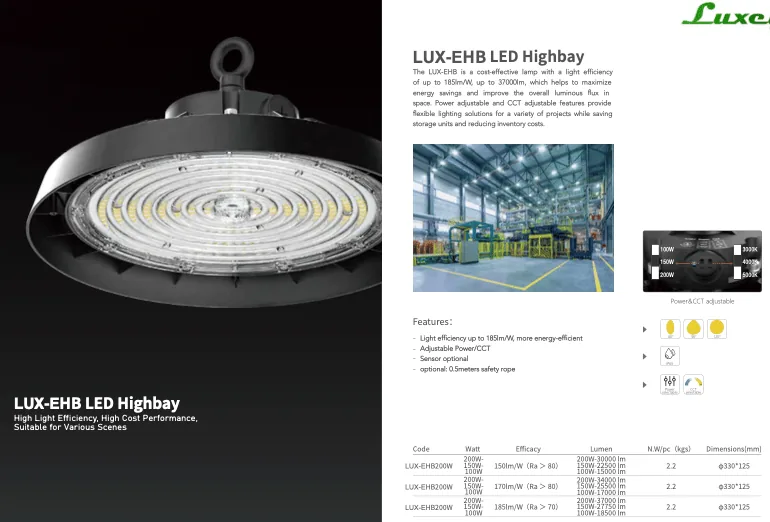
If a fixture has three adjustable parameters — beam angle, power and CCT — and each has four settings, that is 64 combinations from one SKU. For a distributor, that is the difference between stocking 64 product codes and stocking one; for a contractor, it is the difference between a return and a re-order.
The evolution from 1 to 3 adjustable parameters, especially the addition of beam customization, is a game-changer: 🔹 For manufacturers: Boosts sales and reduces inventory. 🔹 For end-users: Simplifies outdoor lighting installation.
Spotlight: Our newly designed industrial and mining light leverages this innovation.
Interested? Contact us for details.
The arithmetic is the argument. Three parameters at four settings each is 4 × 4 × 4 = 64 configurations. Add a second beam option and it doubles to 128. A DIP-switch design collapses that matrix into one box, but only if the switch is accessible after installation and the settings are legible in the dark. Ask for the switching sequence, not just the range.
What are the three adjustable parameters? Beam distribution or angle, power or luminous flux, and CCT (colour temperature). According to analysts at TrendForce, exhibitors at the show put products with all three adjustable in front of engineers, contractors, distributors and wholesalers.
Why does moving from one to three parameters matter? Because adding beam customisation is the step that changes the product. The evolution from 1 to 3 adjustable parameters is described as a game-changer rather than an incremental improvement.
Who benefits, and how? Both ends. For manufacturers it boosts sales and reduces inventory; for end-users it simplifies outdoor lighting installation. The article's own example is a newly designed industrial and mining light built on this idea.
Our 25-engineer team provides free project consultation and fast, accurate quotations.
Get a Quote